An AI trading bot places trades by itself, automatically, once you have connected it to an exchange or broker account and set its rules. An AI trading assistant works differently: it helps you decide, and you place the trade. Both can be useful, and the right one depends on how much control you want to keep. This guide compares them fairly, including five bots, so you can choose.
AI trading bots vs AI trading assistants at a glance
We make AiTradely, an AI trading assistant, not a bot, so read this knowing that. Everything about the other products comes from their own pages, checked on 9 November 2026.
| Question | AI trading bot | AI trading assistant |
|---|---|---|
| Who places the trade | The bot, once its rules are met | You do. The assistant explains and plans |
| What it needs from you | Usually an API key (a permission code) or a broker connection | Often just a sign-in. A broker link is optional |
| How you set the rules | Templates, a visual builder, or code | You ask in your own words |
| How you see its reasoning | Often limited to the rules you set | It writes the reasoning out |
| Risk controls | Whatever the bot or the rules include | You decide each order and its size |
| Best for | Traders with a fixed, tested rule who want it run without them | Traders who want help reading the market and keep the final say |
| Typical cost | Some $0 tiers with limits; paid plans from about $15 a month; robots priced by each seller | Some $0 tiers with limits; paid plans vary widely |
How AI trading bots work
A bot is software that watches a market and sends orders when your conditions are true. Say the rule is: buy when price crosses above its 50-period average and sell when it crosses back below. The bot checks every candle and acts the moment the condition appears. The "AI" label covers a wide range, from plain indicator rules to models that adjust settings. Always check what a product actually does behind the label.
Done well, bots offer real strengths:
- Speed. A bot reacts in seconds, faster than most people can click.
- Discipline. It follows the rule every time. It does not hesitate after a loss or chase after a win.
- Hours. It can run through the night and across sessions you would otherwise miss.
For someone who already has a clear rule that they have tested, that consistency is a genuine advantage.
The risks of trading bots
Rules that worked can stop working. A rule tuned until it looks perfect on past prices may simply have memorised that history. This is called overfitting. When the market changes character, the bot keeps following a rule that no longer fits.
Keys and access. Most bots need an API key to reach your account. Create keys without withdrawal permission, keep them private and review what each key allows. 3Commas, Bitsgap and Coinrule each state on their own pages that they cannot withdraw your funds. Bitsgap also says it rejects any key with withdrawal enabled.
Running unattended. A bot that runs while you sleep can also lose while you sleep. A bad setting, a fast market or a data glitch can repeat the same mistake many times before you notice.
Scams. Regulators warn about this directly. On 25 January 2024 the U.S. Commodity Futures Trading Commission published "Customer Advisory: AI Won't Turn Trading Bots into Money Machines", which says scammers claim AI can produce huge returns using bots and that AI cannot predict the future. The same day the SEC, FINRA and NASAA issued a joint alert, "Artificial Intelligence (AI) and Investment Fraud", which warns about unregistered platforms that promote AI trading systems with claims that profits are certain. Treat any such promise as a red flag, and research the company before you send money.
Five AI trading bots, compared
3Commas. A crypto bot platform with DCA (buying in steps), signal and grid bots, plus Smart Trade (with trailing take profit and stop loss) and a Terminal for manual orders. It connects to supported exchanges through an official integration or API keys, and it says it provides software only. It offers backtesting, and the pricing page says all plans include a demo account. Prices start from $15 a month, but the page does not label the billing period clearly, and that figure is probably the yearly-billing rate. The entry plan is spot only, with one account and a cap on active bots.
Cryptohopper. A crypto bot platform on web, iOS and Android, with templates, indicator-based strategies and a Strategy Designer from the Explorer plan. It has backtesting and a paper trading bot with each subscription. Explorer costs $29 a month, or $24.16 a month billed annually, before VAT. A limit: features scale by plan, and AI strategies are only on the top Hero plan.
Bitsgap. A crypto platform with grid, DCA and futures bots, and an AI Assistant on paid plans. You connect with an API key. It has a demo mode and backtesting that deepens with the plan, from 30 to 365 days. A $0 plan exists, but it has no Grid or DCA bots. Paid plans start at $23 a month on 12-month billing, or $29 billed monthly.
Coinrule. A no-code rule builder for crypto, stocks and ETFs, with a demo exchange and a mobile app to monitor and pause bots. It says its API connections have no withdrawal permissions. It has a $0 plan and paid plans from $29.99 a month. The limit: the $0 plan is small (2 live rules, 1 exchange), and the site is not available to EU or EEA residents.
Expert Advisors on the MQL5 Market. These are robots for MetaTrader that sellers list on a marketplace. Markets vary by robot: the marketplace describes forex and stocks, and many target gold. Each is code from its seller, and you usually adjust input settings. Demos can be tested in the terminal's Strategy Tester. Prices are set by each seller and ranged from $30 to about $3,198 in the listings we saw, and some are rented. The limit: quality varies listing by listing, so check each description and demo.
How AI trading assistants work
An assistant reads the market and tells you what it sees. You still choose whether to act. The strengths are speed of research and clear explanations: instead of opening five charts, you ask one question. The limits are the mirror image of a bot's: nothing happens unless you act, and you need to be present to make the decision.
TrendSpider Sidekick is an agentic assistant built into the TrendSpider platform. It researches securities, analyses charts, builds scanners, indicators and alerts, and develops and backtests rules-based strategies. Its page says it does not independently place, modify or close trades, and that it can misunderstand instructions, so outputs should be checked. Sidekick has a free tier of up to 25 messages a month, and paid add-ons from $49 a month.
TradingView's AI Copilot sits in the side panel of Supercharts. It changes symbols and indicators, draws levels, writes Pine Script and manages alerts. Its help page says it does not give financial advice or tell you what to buy or sell, and that it can be wrong or use outdated information. It is an add-on on every paid plan, on web and desktop, and not yet in the mobile apps.
AiTradely
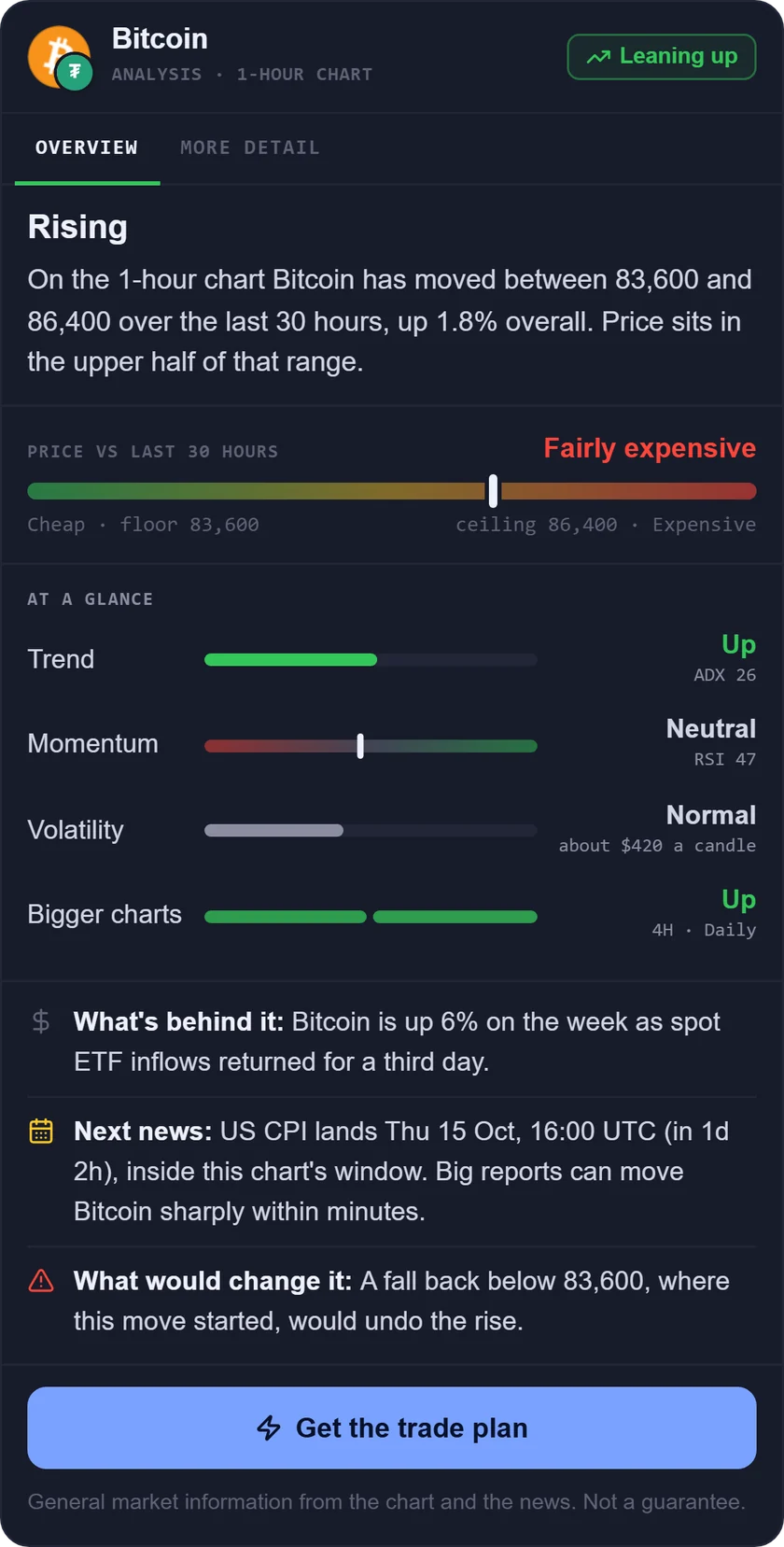
What it is: an AI trading assistant on iPhone, Android and the web. You ask about a market in your own words, and it reads live prices, indicators, today's news and the economic calendar before it answers.
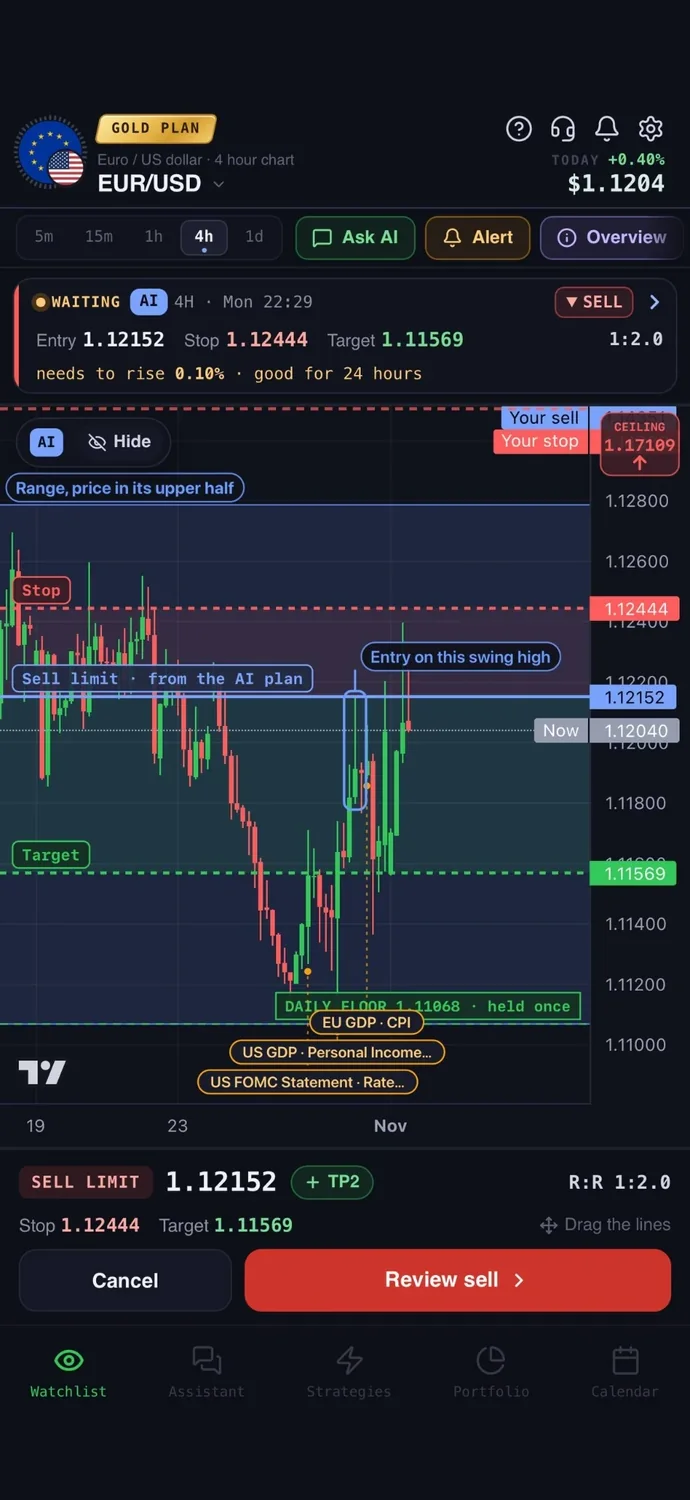
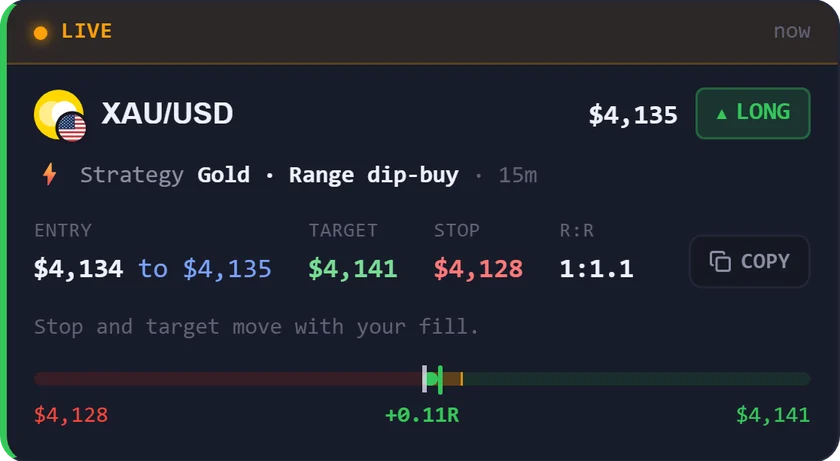
What it does: it reads the market for you and explains its reasoning in plain words: a plan with an entry, a stop loss, a take profit and what would cancel the idea. A strategy builder lets you describe a rule in words, test it on past prices, and get a push and a Telegram message when it fires, so it watches the market while you are away without ever placing a trade itself. You can connect a broker account and place the order from the app: for cTrader on the Trader and Gold plans, and for MetaTrader 5 on the Gold plan. You confirm every order, and your money stays with your broker.
Easy to start: sign in with Google or Apple and type your first question the way you would ask a friend who trades. There is no code to write and nothing to set up first.
Price: your first questions and your first trade plan are on us; after that, the paid Trader and Gold plans are priced by country (see the pricing page).
Keep in mind: it is not a bot: if you want trades placed automatically while you sleep, a bot does that and AiTradely does not. It is an analysis tool, not a robot, and it never places a trade without your confirmation.
Which do you need?
- You have a clear, tested rule and want it executed without you at the screen: a bot.
- You trade crypto and want grid or DCA style automation: a bot.
- You want the market explained and a plan with entry, stop and target: an assistant.
- You are still learning what a good setup looks like: an assistant.
- You want to confirm every order yourself: an assistant.
- You want an alert when your conditions appear, but a final say on the trade: an assistant with alerts.
Some traders use both: an assistant to research and refine a rule, then a bot to run it. Whichever you pick, size positions carefully with a position size calculator.
More comparisons: the best AI trading apps, the best AI apps for gold trading, TradingView alternatives, ChatGPT for trading vs AI apps, the best forex trading apps, the best trading apps for beginners, the best crypto trading apps, the best gold trading apps, the best AI for stock trading, the best trading journal apps, backtesting without coding and the best AI apps for MetaTrader 5.
Common questions
01Are AI trading bots profitable?
No tool can promise profit, and past results do not promise future ones. A bot only repeats its rules faster, so a weak rule loses faster too.
02Are AI trading bots legal?
Using a bot on your own account is generally allowed, but rules differ by country and by exchange or broker, so check yours. Selling bots with claims that profits are certain is what regulators target.
03Can an AI assistant trade for me?
No. An assistant analyses and plans, and you place or confirm every order. In AiTradely, nothing is sent to your broker until you confirm it.
04What is the best AI trading bot?
There is no single best AI trading bot. It depends on your market, your rules and how much you want to configure, so test any bot in demo mode first.
Getting started with an AI trading assistant
- Sign in with Google or Apple.
- Ask about a market in your own words, for example whether gold looks stretched on the 1h chart.
- Read the plan and its reasoning, then set an alert or place the order yourself.
If you want to go one step further, describe a rule in the strategy builder, test it on past prices and let an alert tell you when it fires. You keep the decision, and you can look at the AiTradely features to see what else fits your style.
Nothing here is financial advice. Any automated system can repeat a bad rule many times before you notice, so test in demo mode and keep position sizes small.
 AiTradelyYour AI trading analyst, in your pocketAI analysis for gold, forex and stocks. Build and backtest strategies, get signals, and trade from your own broker account.
 On your phoneScan for the app