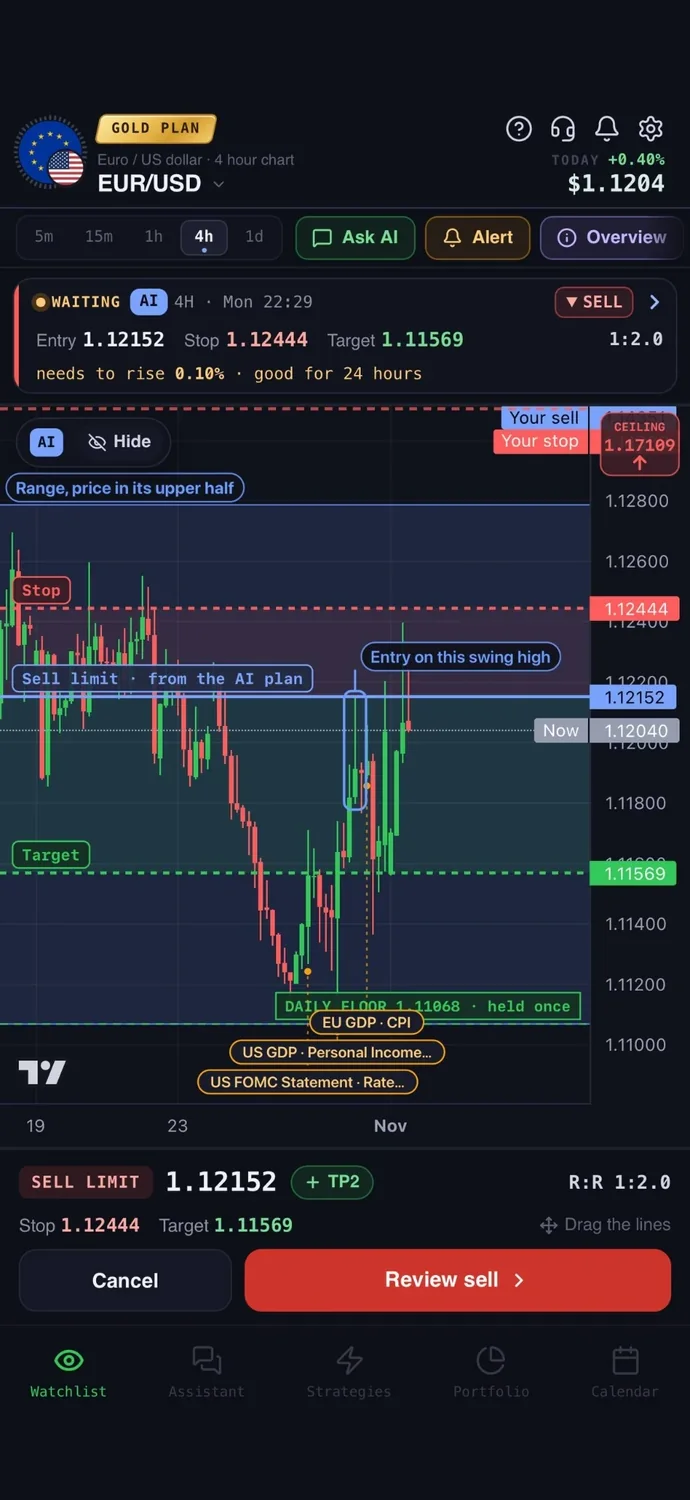
To trade on forex, you learn how currency pairs are quoted, choose a provider you have checked for proper authorisation, practise on a forex demo account, and write a simple plan that fixes your risk before any order goes in. The steps below follow that order and include one worked EUR/USD example with made-up numbers. None of it needs a large account, but it does need patience before real money is involved.
Understand How Forex Trading Works
Forex, short for foreign exchange, is the market where one currency is swapped for another. As a guide to forex trading basics explains, every trade buys one currency and sells another at the same time, and a trader speculates on whether that exchange rate will rise or fall.
Two very different things share the name. Changing ringgit into dollars for a holiday is a currency exchange: you own the money you receive. Forex trading for beginners usually means a leveraged contract where you never hold the currency and only gain or lose on the price change. Depending on the provider, that contract may be a spot forex position, a CFD (contract for difference) or another product, each with its own costs and rules. First find out exactly which instrument you would be trading and under which provider's terms.
Read a Currency Pair
Currencies are quoted in pairs. In EUR/USD, the euro is the base currency (the first one) and the US dollar is the quote currency (the second one). A price of 1.1000 means one euro costs 1.1000 US dollars.
- Buying EUR/USD (going long) means you expect the euro to strengthen against the dollar, so the price rises.
- Selling EUR/USD (going short) means you expect the euro to weaken, so the price falls. You can sell first without owning euros because you trade a contract.
You will always see two prices. The bid is the price at which you can sell, and the ask is the price at which you can buy. The gap between them is the spread, a cost on every trade. Say EUR/USD shows 1.1000 / 1.1002: you buy at 1.1002, but closing at once you would sell at 1.1000, so you start slightly behind.
A pip is the standard unit of price movement. For most pairs it is the fourth decimal place (0.0001), so 1.1000 to 1.1002 is a 2-pip spread. For pairs quoted against the Japanese yen it is the second decimal place (0.01).
Position size is how much of the base currency you trade. Many providers use lots: a standard lot is 100,000 units, a mini lot 10,000 and a micro lot 1,000, though sizes and minimums differ by provider. Size decides what each pip is worth. On EUR/USD, 10,000 units makes each pip worth about 1 US dollar, and 1,000 units about 0.10 dollars. If your account is in ringgit, that dollar result is converted at the current rate.
Understand Leverage and Margin
Leverage lets you control a position larger than the money you put up. Margin is the deposit the provider holds while the trade is open. Leverage is the reciprocal of margin, so a 5% margin requirement is the same as 20:1 leverage, as this explainer on leverage and margin shows.
A position of 10,000 euros at 1.1000 is worth 11,000 dollars. With a 5% margin requirement, the provider holds 550 dollars as margin.
The key point for a beginner: margin is not the most you can lose. Your profit or loss comes from the price move on the full 11,000-dollar position. A 100-pip move against you on 10,000 units costs about 100 dollars. A 600-pip move costs about 600 dollars, more than the margin held. Leverage magnifies losses exactly as much as gains.
If losses shrink your account below the level needed to support open positions, the provider may ask you to add funds (a margin call) or close positions for you (a margin closeout). The thresholds, maximum leverage and closeout rules depend on the regulator and the provider. Read your own provider's margin policy rather than assuming another firm's rules apply to you.
Choose a Broker and Check Its Regulation
How to start forex trading safely mostly comes down to who holds your money. Scams copying real company names are common, so check the provider yourself rather than trusting an advert, a group chat or a friend's screenshot. This guide rates no broker; use the checklist instead.
- Legal entity. Find the exact company name and registration number that would hold your account. Groups often run several entities with different protections.
- Official website. Confirm the web address through the regulator's record, not a link someone sent. Clone sites copy names, logos and licence numbers.
- Regulator. Note which authority licenses that entity, then look the entity up on the regulator's own website.
- Permitted services. A licence covers specific activities. Check that the one you need, such as dealing in leveraged contracts, is listed.
- Availability in your country. Confirm that entity offers the product to residents of your country. A licence from one country does not, by itself, show a firm may serve clients in another.
- Costs. List spreads, commissions, overnight financing (swap) charges, inactivity fees and currency conversion costs.
- Deposits and withdrawals. Read how withdrawals work, how long they take and what they cost. Be wary of any firm that makes withdrawals hard or asks for more deposits to release your money.
For readers in Malaysia, start with the SC Investment Checker. It verifies whether an individual or entity is authorised by the Securities Commission Malaysia to offer, promote or sell capital market products and services in Malaysia, and shows names on the SC's Investor Alert List. It covers SC-regulated activities only, so it is not a universal register of every kind of currency dealing. Not finding a name does not settle the question either way, and other rules or authorities may apply depending on the product. If unsure, contact the SC through that page. Tax or religious questions are separate matters for a qualified adviser or authority.
Practise on a Demo Account
A forex demo account is a practice account funded with virtual money on live or near-live prices, the place to learn the mechanics without paying for mistakes. A useful path:
- Learn the platform. Find the bid and ask, the spread, your balance, equity, margin used and free margin. Know where open positions and order history appear.
- Place each order type. Open and close a market order, set a limit order and a stop order, then attach a stop-loss and a take-profit to each.
- Change the size. Open the same trade at 1,000 and 10,000 units and watch how the value of each pip changes.
- Watch margin. See how margin used and free margin move as you add positions.
- Trade your written plan. Once the buttons feel familiar, take only trades that match the plan from the next step and record every one.
Set the demo balance to an amount you would realistically deposit; a large virtual balance teaches sizes you could never use.
Know the limits. A demo shows you can operate the platform; it does not prove you are ready for real losses, which feel very different with your own money. Demo fills may also be smoother: spreads, slippage (getting a worse price than requested) and execution speed can differ live. Treat demo results as a test of your process, not a forecast.
Build a Simple Trading Plan
A trading plan is a short set of written rules decided before the market moves. It should answer these questions:
- Instrument. Which pair or pairs you trade, and on which timeframe.
- Setup conditions. What must be true before you enter. For example: price is above its 50-period moving average and pulls back to a level that held before. Write it so someone else could check it.
- Invalidation. The price or event that proves the idea wrong. This is where your stop-loss goes, based on the chart rather than on how much you hope to make.
- Acceptable risk. The most you will lose on one trade, as a money amount, set only by you from money you can afford to lose. There is no universal right deposit, leverage or percentage.
- Target and reward. Where you plan to take profit, and how that distance compares with your risk. The risk/reward ratio guide explains how to weigh the two.
- Costs. Spread, any commission, and overnight financing if you hold past the daily rollover. On short trades with small targets, costs can take a large share.
- Events to recheck. Which scheduled releases affect your pair, such as central bank decisions or employment data, and what you do before them: stand aside, reduce size or recheck the setup.
Once you know the stop distance and the money you will risk, size follows: risk amount divided by (stop distance in pips multiplied by the value of one pip per unit). The position size calculator does that arithmetic for you.
Place and Manage a Trade
Small slips get expensive here, so follow the same routine every time.
- Check the calendar. Look for scheduled events on either currency; spreads can widen and prices jump around major releases. If this is new, see how to read an economic calendar.
- Choose the pair and direction. Confirm the symbol and that buy or sell matches your plan.
- Set the size. Enter the size you calculated, and check whether the platform shows units or lots.
- Choose the order type. See the table below.
- Attach the stop-loss and target. Enter them as prices, then check the distance in pips.
- Review before confirming. Check the summary: pair, direction, size, entry, stop, target, spread and margin required. Then confirm.
| Order type | What it does | Limitation |
|---|---|---|
| Market | Buys at the current ask or sells at the current bid, straight away | You get the next available price, which may differ from the quote in a fast market |
| Limit | Buys below or sells above the current price, at your price or better | If price never reaches your level, the order is not filled |
| Stop | Buys above or sells below the current price once that level trades, often used to enter a breakout | Once triggered it fills at the next available price, which can be worse than your level |
A stop-loss is a stop order that closes your position. Once its level is reached it becomes a market order, so in a gap or fast move it can fill worse than you set. Only a guaranteed stop, where offered and usually at extra cost, removes that risk. A stop-limit is different: once triggered it places a limit order, so it never fills worse than its limit, but if price jumps past it the order may not fill and the position stays open.
A worked example (illustrative numbers, not real quotes). Say EUR/USD shows 1.1000 / 1.1002 and your plan calls for a long trade.
- You buy 10,000 units at the ask, 1.1002. Each pip is worth about 1 dollar.
- Your idea is invalid below a recent low, so the stop goes at 1.0972: 30 pips, a planned loss of about 30 dollars.
- Your target is 1.1062: 60 pips, about 60 dollars. That is a 1:2 risk to reward before costs.
- At 5% margin, about 550 dollars is held (5% of 11,002). That is not your risk.
- A long position closes at the bid. Right after entry the bid is 1.1000, so the trade shows about minus 2 dollars: that is the spread. Because the stop and target are measured from the 1.1002 you paid, the spread is already inside the 30 and 60 pips. With, say, a 1-dollar commission each way (2 dollars in total), the real loss at the stop is about 32 dollars and the real gain at target about 58 dollars.
- If the price gaps below 1.0972 over a weekend and opens at 1.0950, the stop fills near 1.0950 and the loss is about 52 dollars before commission, not 30.
The example shows how the numbers fit, not whether the target would be reached.
Managing the open trade means sticking to the plan: never move the stop further away to avoid a loss, recheck before scheduled events, and write any adjustment and its reason in your journal.
Review Your Trades Before Moving to Live Trading
A trading journal turns practice into feedback. For every trade, record:
- Date, pair, timeframe and direction
- The setup conditions you saw, with a chart screenshot
- Entry, stop, target and position size
- Costs paid and the final result in pips and money
- Whether you followed the plan, and how you felt
Every 20 or so trades, review the journal and split losing trades in two: ones where you followed the plan and the market went the other way, which is normal, and ones where you broke a rule, which is what to fix. Common examples are entering without all conditions met, moving the stop, trading through a release you meant to avoid, or sizing up after a loss.
There is no required learning period and no stage at which profit is assured. Base the decision on your journal: you follow your rules consistently, understand every cost, and have set a loss amount you can truly afford. Many traders then start live with the smallest size the provider allows, because real money tests discipline in a way a demo cannot.
Before your first live trade, check that you can answer yes to each line:
- I know exactly which instrument I am trading and its costs.
- I have checked the provider's entity, regulator, permitted services and availability for my country.
- I can read bid, ask, spread and pips, and I know my pip value at my chosen size.
- I understand that margin is not my maximum loss.
- I have a written plan with conditions, invalidation, risk amount and target.
- I have practised every order type on a demo account.
- I check the economic calendar before entering.
- My journal shows I follow my plan.
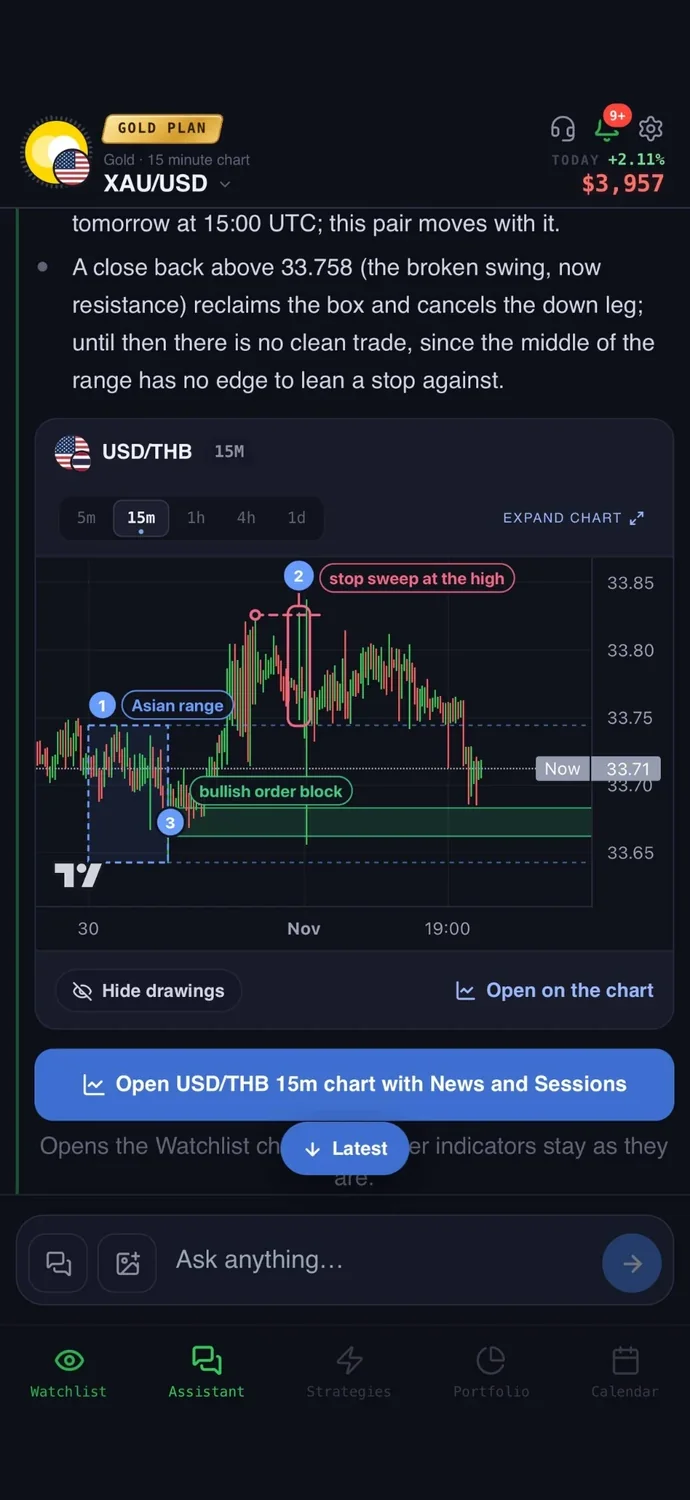
When you start analysing pairs for real, the daily analysis in AiTradely gives each forex pair a direction with the reasoning written out, and you can ask the AI assistant why EUR/USD is moving or what is on the economic calendar this week. Compare that reasoning with your own plan, keep logging the result in your journal, and decide every entry yourself.
Nothing here is financial advice. Leveraged forex trading can lose more than your margin, and stop-loss orders may fill at worse prices in fast or gapping markets.
 AiTradelyYour AI trading analyst, in your pocketAI analysis for gold, forex and stocks. Build and backtest strategies, get signals, and trade from your own broker account.
 On your phoneScan for the app