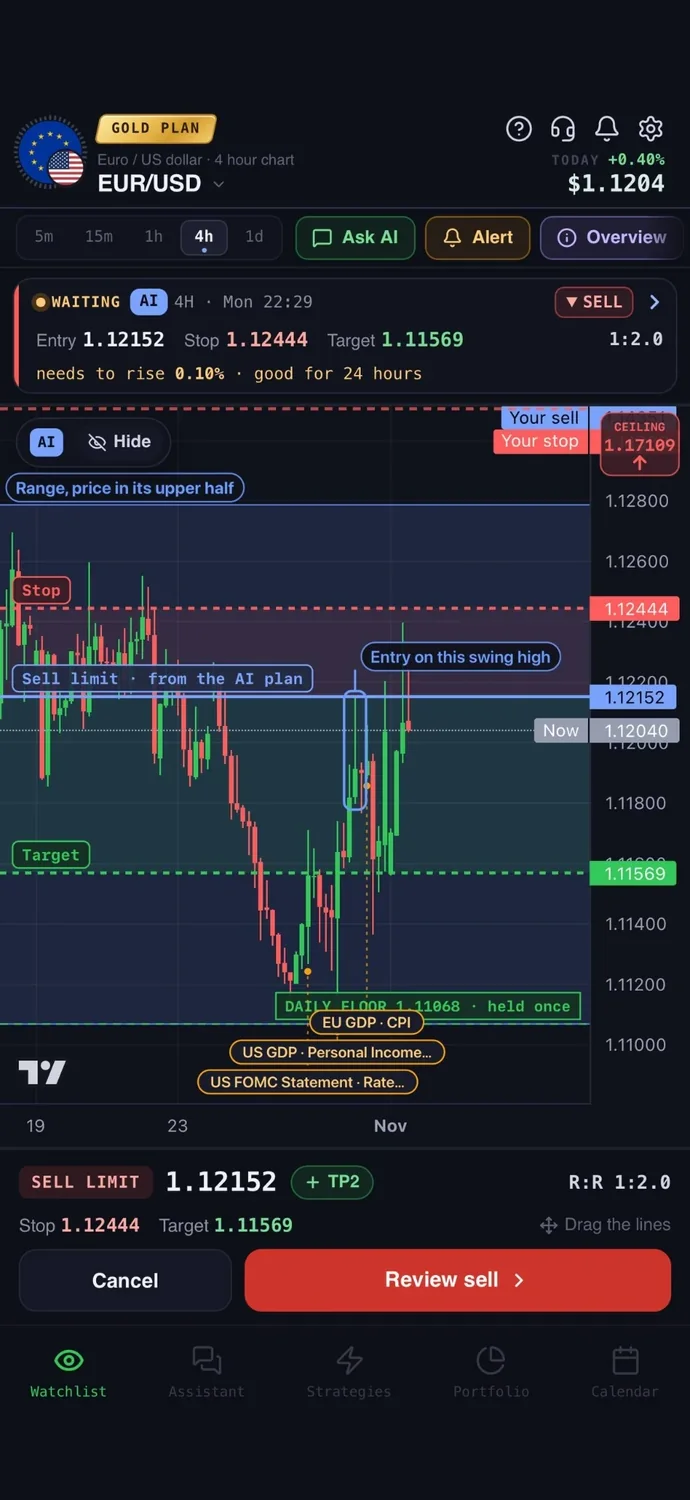
Forex market hours run 24 hours a day from Monday to Friday, and in Malaysia that works out to roughly Monday morning to Saturday morning in MYT (UTC+8). The market has no single exchange, so the "sessions" in Sydney, Tokyo, London and New York are busy windows, not official opening bells. Below are the session times in MYT, the London and New York overlap, and what changes when clocks move abroad.
How Forex Market Hours Work in Malaysia
The main currency market trades around the clock during the working week and closes over the weekend. It is an over-the-counter market: banks, brokers and dealers trade with each other through networks, not on one exchange with fixed hours. Activity passes from one financial centre to the next as the day moves around the world.
Malaysia Time (MYT) is UTC+8 all year. Malaysia does not change its clocks, so MYT never shifts. What shifts is the clock in London, New York and Sydney, and that moves the session times you see in MYT.
Two ideas are easy to mix up:
- Centre activity windows. Rough periods when traders in a city are at work. They are conventions, and sources draw them differently.
- Broker availability. The exact hours your broker lets you place and close trades for a given product. These come from the broker, not from a session chart.
If you are new to all this, forex trading for beginners covers the basics first. Then come back here to plan your day around MYT.
Forex Session Times in MYT
The table uses one teaching convention: a nine-hour window from 08:00 to 17:00 local time in Sydney, London and New York, and 09:00 to 18:00 in Tokyo. These are illustrative windows, not exact market boundaries. Other sources use different hours, for example the forex session hours guide lists its own windows in GMT, so never mix numbers from two sources without checking the convention.
| City (time zone) | Local hours | MYT on standard time | MYT on daylight saving time |
|---|---|---|---|
| Sydney (Australia/Sydney) | 08:00 to 17:00 | 06:00 to 15:00 (AEST) | 05:00 to 14:00 (AEDT) |
| Tokyo (Asia/Tokyo) | 09:00 to 18:00 | 08:00 to 17:00 | No change, Japan has no daylight saving |
| London (Europe/London) | 08:00 to 17:00 | 16:00 to 01:00 next day (GMT) | 15:00 to 00:00 next day (BST) |
| New York (America/New_York) | 08:00 to 17:00 | 21:00 to 06:00 next day (EST) | 20:00 to 05:00 next day (EDT) |
A time of 00:00 belongs to the start of the next calendar day in MYT. The London and New York rows therefore run past midnight, which matters for anyone who trades in the evening after work.
Note that Sydney's daylight saving period is the opposite of London and New York. Its summer time (AEDT) runs while the north is on winter time.
London–New York Overlap in Malaysia
The overlap is the stretch when both the London and New York windows are open. Many traders watch it because two large financial centres are active at once. In MYT it falls late in the evening:
| Clock setting | London | New York | Overlap in MYT |
|---|---|---|---|
| Both on standard time | GMT | EST | 21:00 to 01:00 next day |
| Both on daylight saving | BST | EDT | 20:00 to 00:00 next day |
| Mixed | GMT | EDT | 20:00 to 01:00 next day |
The UK and the US change their clocks on different dates. For a few weeks in March, and again between late October and early November, London is on GMT while New York is still on EDT. That is the mixed row. So the first two rows do not cover the whole year, and a fixed overlap time you saved last season can be an hour off.
Busy does not mean easy or profitable. An active period does not guarantee a narrow spread, a clean trend or a winning trade, and no single session is the best for every pair. A pair such as USD/JPY may be more active in Tokyo hours, while EUR/GBP leans toward London. Check how your own pair behaves.
Why Daylight Saving Changes the MYT Schedule
London, New York and Sydney each move their clocks on their own dates, and each shift changes the gap to MYT by one hour. Because MYT stays fixed, the whole schedule moves around it.
Here is a dated example for 28 October 2026. It is an example for that day, not the current setting forever:
- London went back to GMT after 25 October, so its window is 16:00 to 01:00 next day in MYT.
- New York is still on EDT until 1 November, so its window is 20:00 to 05:00 next day in MYT.
- Sydney is on AEDT, so its window is 05:00 to 14:00 in MYT.
That means London and New York overlap from 20:00 to 01:00 next day on that date, which is the mixed setting. After 1 November, New York moves to EST and the overlap becomes 21:00 to 01:00.
The rules for each place are published by official bodies. GOV.UK lists the UK clock change dates, and NIST explains the US rules. If you read this article later in the year, recalculate with the table above instead of copying the example date.
Weekly Open, Close and Broker Breaks
A common reference point is 17:00 in New York on Sunday for the weekly open and 17:00 on Friday for the weekly close. In MYT, that is about 05:00 on Monday and 05:00 on Saturday while New York is on EDT, and about 06:00 on Monday and Saturday while it is on EST.
Treat that as a guide only. The exact minute your broker opens, and any short daily pauses, are set in the broker's own specification. Do not assume the start of the Sydney session is the one official opening of the whole market, because there is no single official opening.
As one example of a specific provider, the instrument trading hours page lists forex products as Sunday 17:05 to Friday 16:59 New York time, with a daily six minute pause from 16:59 to 17:05 New York time inside the trading week. It is not a break at the weekly close: the Friday close is what starts the weekend. Metals, indices, crypto and other products have different hours on the same page. This is one provider's schedule, not a rule for the whole market, and not a recommendation.
Three more points:
- Public holidays can change hours. Check your broker's notice for each date instead of relying on a general calendar.
- Some companies offer weekend products. Those are their own instruments and are not the same as the regular forex market.
- When the market is closed, you generally cannot open or close positions. Prices can still move on news, and the market may reopen at a different level (a gap).
Check the Schedule Before You Trade
Run through this short checklist before you plan a trade around a session:
- Pair and product. Confirm the exact instrument you will trade, since hours differ between forex, metals and others.
- Server time zone. Many platforms show candles in the broker's server time, not MYT. Find the offset.
- Date. Note today's date, because the answer depends on the season.
- Daylight saving of the source city. Check whether London, New York and Sydney are on standard or summer time right now.
- Instrument schedule and holidays. Read your broker's hours and any holiday notices.
- News. Look at the day's scheduled events with an economic calendar, with times converted to MYT.
Timing matters for risk too. Spreads, the gap between the buy and sell price, tend to widen around the weekly close and big news, and prices can gap when the market reopens. An ordinary stop loss is not a guarantee of price: it can fill at a worse level than the one you set, so a planned risk is not a guaranteed maximum loss.
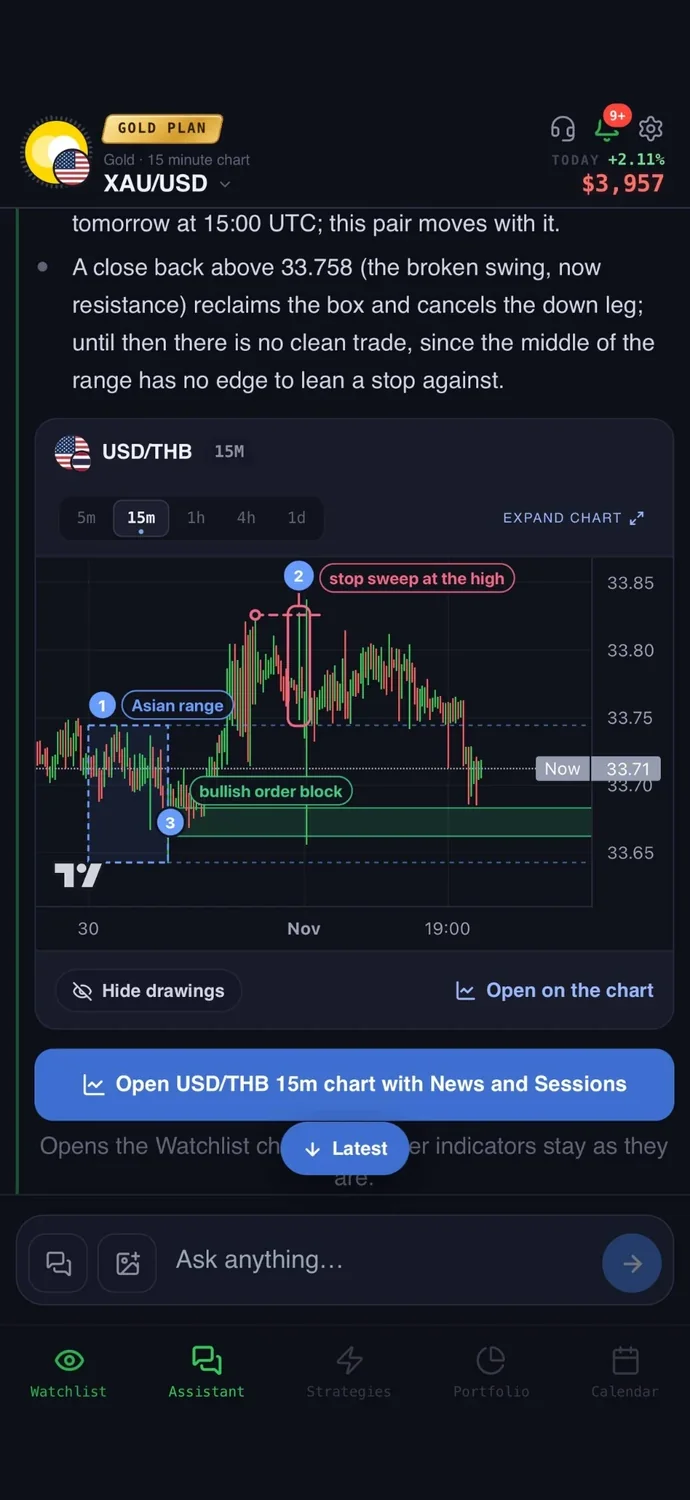
Once you know when your pair is active in MYT, the next step is looking at what the market is doing in that window. In AiTradely you can ask the AI assistant about a pair and read the daily analysis with its reasoning written out, then check the economic calendar for the events that move that asset before you decide anything yourself.
Nothing here is financial advice. Trading around session changes and market closes can mean wider spreads and price gaps, and a stop order may fill at a worse price than you set.
 AiTradelyYour AI trading analyst, in your pocketAI analysis for gold, forex and stocks. Build and backtest strategies, get signals, and trade from your own broker account.
 On your phoneScan for the app