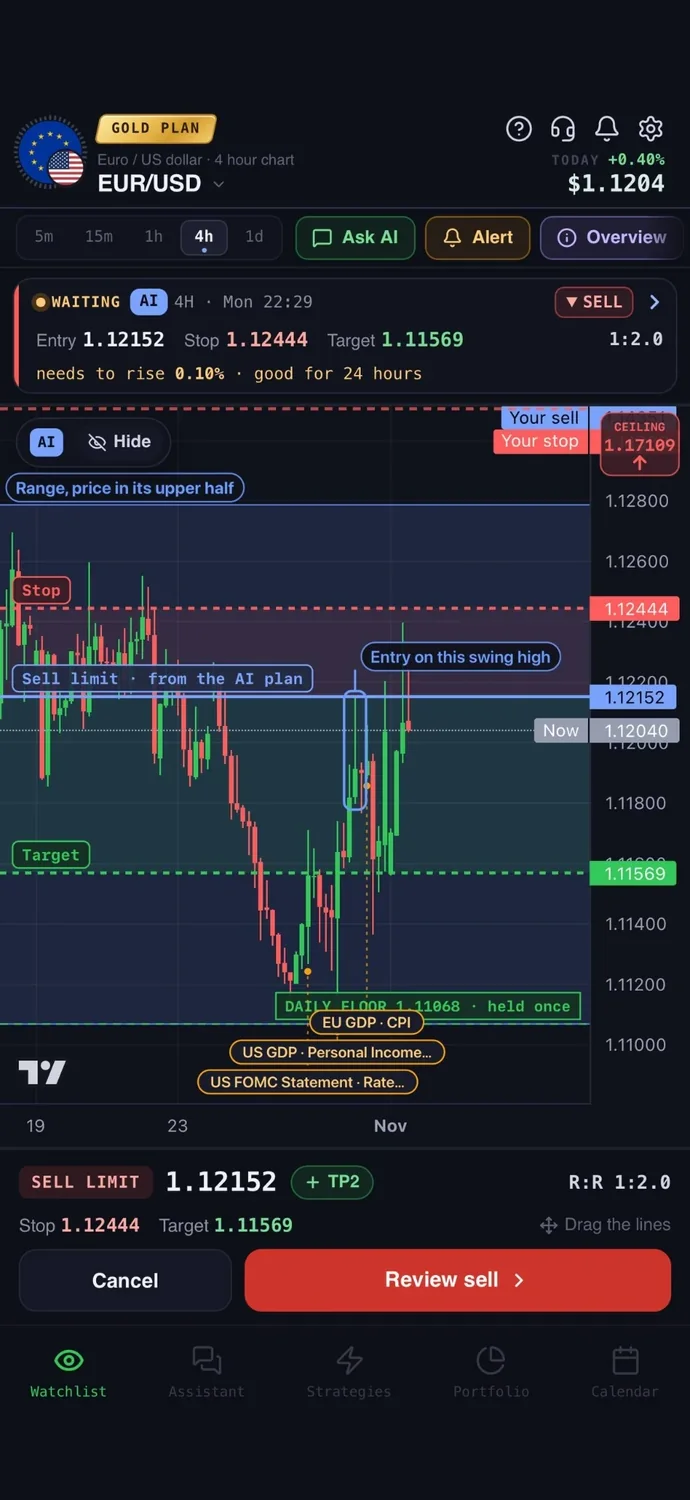
The AiTradely vs Tickeron question comes down to who makes the decision. Tickeron is built around AI-generated trading ideas and ready-made models you can follow. AiTradely is built around your own rules: you describe a strategy, test it on past data, and get an alert when it fires. On AiTradely the AI never trades for you. You decide and place every trade.
AiTradely vs Tickeron: who each one is for
The simplest way to choose is to ask whether you already have a way of trading.
Tickeron suits a trader who does not yet have a strong view of their own and wants a system that proposes ideas. It also suits someone who likes the idea of choosing from a menu of pre-built AI approaches, rather than writing the logic themselves. If you would rather start from the tool's suggestions and judge them as they come, that model fits.
AiTradely suits a trader who already has a way of reading charts, even a simple one, and wants it written down as an exact rule, tested, and watched around the clock. It also suits a beginner who wants to learn why a setup is a setup, because the daily analysis writes out its reasoning and the assistant explains answers in plain language.
A useful test: can you finish the sentence "I buy when..."? If yes, a rule-based tool will feel natural. If not, a tool that offers ready-made ideas may feel like a better starting point, though you should still understand any idea before you act on it.
How each works day to day
With Tickeron, the routine is mostly about selecting and monitoring. You browse the AI models and robots on offer, pick the ones that match your market and style, and follow what they produce. Your daily work is deciding which suggestions to act on and how much to risk on each.
With AiTradely, the routine starts with a rule. You build a strategy in the no-code builder from conditions such as RSI, MACD, moving averages, Bollinger Bands, volume, price levels, market structure and candle patterns, on a chart from 5 minutes to 1 day. You backtest it on history to see how the rule behaved, then switch on an alert. When the conditions line up, you get notified and decide what to do.
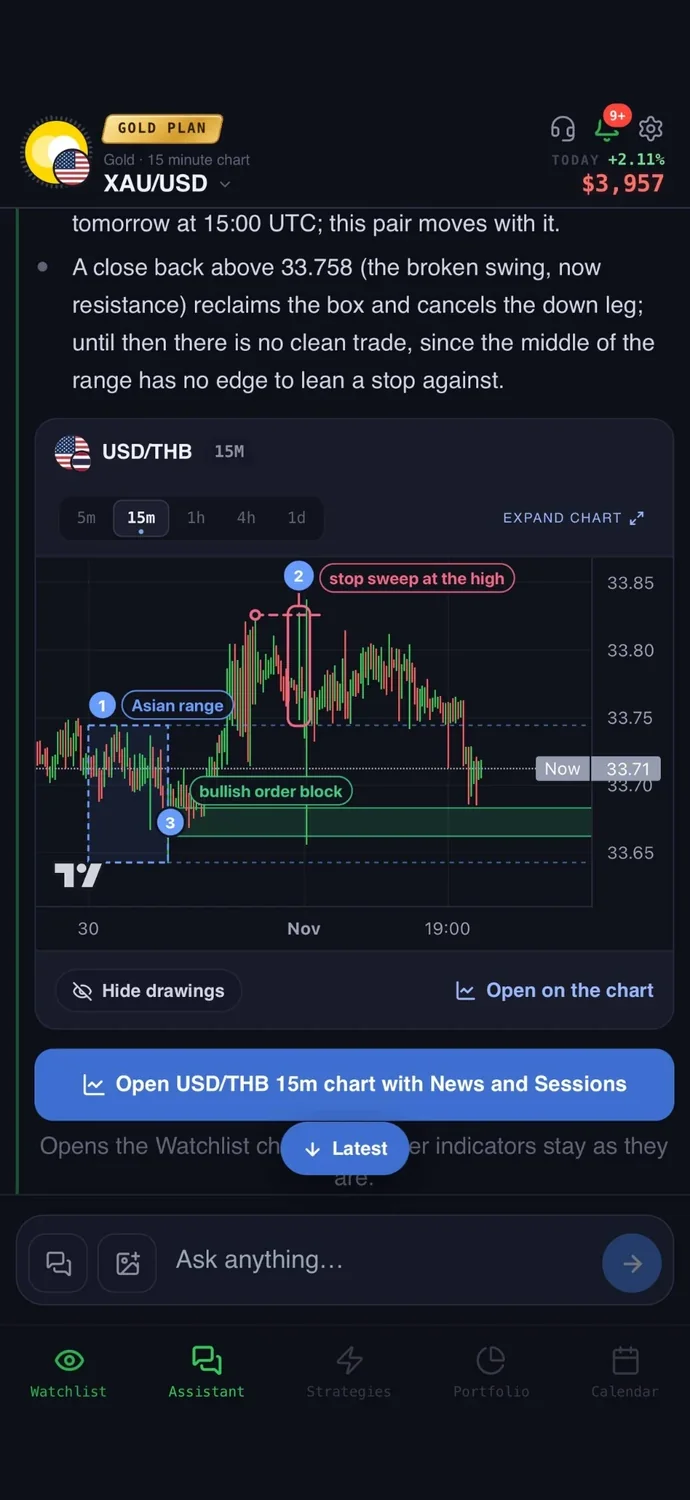
Between alerts, you can ask the AI assistant about any covered asset and it answers from live prices, indicators and news. Each asset also gets a daily analysis with its direction and the reasoning written out. When you want a plan, trade plans give an entry, a stop and a target built by rules from the chart on the timeframe you pick. Before any trade, the economic calendar shows the events that move that asset.
If you decide to act, you can place the trade from the app on your own cTrader or MetaTrader 5 account. That step is always yours.
What each does not do
Every tool has limits, and knowing them saves money and frustration.
Where Tickeron is stronger. Tickeron offers a ready-made catalogue of AI approaches, so you can begin with ideas already built for you. AiTradely does not hand you a library of robots to follow. It also does not claim to replace your judgment with a pre-packaged model. If you want a wide menu of pre-built systems to browse, Tickeron does that better. Tickeron is also a longer-established name in AI-driven trading ideas, which some readers will weigh.
What AiTradely does not do.
- It does not trade for you. Every order is placed by you.
- It does not sell signals. An alert only tells you that your own rule fired.
- It cannot test chart patterns such as head and shoulders, double tops, triangles or flags, because the builder has no condition for them. You can still study them, for example in our guide to the head and shoulders pattern, and judge them by eye.
- It has no opening range condition.
- It does not cover indices.
- A backtest describes how a rule behaved on past data. It does not tell you what happens next.
What to check on Tickeron. Before you commit, read its own pages for what its models actually do, which markets and timeframes they cover, and what it says about how its results are measured. Terms change, so rely on its current documentation rather than on any summary, including this one.
Side by side in plain sentences
On the core idea, Tickeron gives you AI-made ideas to follow, while AiTradely gives you tools to test and monitor your own.
On control, Tickeron asks you to trust its models and choose among them. AiTradely keeps the logic in your hands, and you can read every condition in the rule.
On learning, AiTradely writes out its reasoning in the daily analysis and lets you question the assistant. Tickeron's strength is breadth of ready-made options rather than teaching you to build your own.
On markets, AiTradely covers crypto, forex, gold and other commodities, and stocks. Check Tickeron's own site for its current coverage.
On cost, compare current terms on each provider's own site, and weigh them against how much of the tool you will actually use.
On execution, AiTradely never trades on its own. You can place a trade from the app on your own cTrader or MetaTrader 5 account, or take it elsewhere. If you want to see how an AI approach compares with classic indicators, our piece on AI trading analysis vs traditional tools goes deeper.
Common questions
01Is AiTradely a Tickeron alternative?
It can be, if you prefer to write and test your own rules instead of following ready-made AI models. The two tools start from different ideas, so they are not a like-for-like swap.
02Does AiTradely give buy and sell signals like Tickeron?
No. AiTradely does not sell signals. It alerts you when a rule that you defined is met, and you decide whether to trade.
03Can I use both together?
Nothing stops you. Some traders compare an outside idea against their own tested rule before acting. Whatever you use, size every position so one loss stays small, and our position size calculator helps with that.
04Which is better for a beginner?
It depends on your goal. If you want to learn how setups work and build your own method, a rule-based tool teaches more. If you want to see ideas first, a ready-made catalogue can be a starting point, as long as you understand what you are acting on.
Putting it into practice
Pick the tool that matches how you want to decide. If you want to follow ready-made ideas, compare Tickeron's current offer against your needs. If you want your own method tested and watched, write the rule down first, in plain conditions, and judge it by its stop, target and risk reward ratio before anything else.
If the second route fits, the strategy builder in the AiTradely app is the natural next step: describe your conditions, backtest them on the timeframe you trade, and set an alert for when they fire. The daily analysis on the asset you watch then gives you a written view to check your rule against.
Nothing here is financial advice. Any tool, AI or rule-based, can look convincing on past data and still lose money in live markets, so risk only what you can afford to lose.
 AiTradelyYour AI trading analyst, in your pocketAI analysis for gold, forex and stocks. Build and backtest strategies, get signals, and trade from your own broker account.
 On your phoneScan for the app