Lesson 7 · 10 min

Risk in dollars

Decide how many dollars you accept to lose before the trade, then let the size follow. The one skill that keeps you trading.

  1. 1
  2. 2
  3. 3
  4. 4
  5. 5
  6. 6
  7. 7
  8. 8
  9. 9
  10. 10
  11. 11
  12. 12
Step 1

Pick your loss per trade, in dollars

Before any trade, choose the most you accept to lose on it, in dollars. A good test: could you lose it ten times in a row and still sleep well? For many beginners that is $5 or $10. This number is your risk per trade, and it stays the same whatever the market, whatever the chart looks like.

Total: -$100

Ten planned losses in a row: painful, but you are still trading and still learning.
Step 2

The size comes from a sum

Divide your risk in dollars by the distance from the entry to the stop. On gold, every ounce gains or loses $1 for each $1 the price moves. So with a stop 10 away, each ounce can lose $10, and $10 of risk buys exactly 1 ounce. If the stop is hit, you lose $10. Not more.
$10your risk
10entry to stop
1 ozyour size
Buy at 4,110, stop at 4,100: 10 dollars of movement per ounce. With $10 of risk, that is 1 ounce.
Step 3

A wider stop means a smaller size

The stop goes where the idea is wrong (lesson 6), not where it is convenient. So the stop decides the distance, and the size adapts: a wide stop gets a small size, a tight stop a bigger one. This is the whole trick. Whatever the chart, the loss is the number you picked in step 1.

Too small to trade? Most brokers sell gold in steps of 1 ounce at the smallest. If your sum says 0.5 ounce, you can take a plan with a closer stop, raise your risk to $20 on purpose, or skip the trade. Never round the size up and hope.

STOP DISTANCESIZELOSS AT STOP
52 ounces-$10
101 ounce-$10
200.5 ounce-$10
The loss at the stop is the same $10 every time. Only the size changes.
Step 4

Lots and pips: the broker's units

Brokers count size in lots. On gold, 1 lot is usually 100 ounces, so 0.01 lot is the 1 ounce from step 2. On currency pairs, prices move in pips (0.0001 on EUR/USD), and 0.01 lot moves about $0.10 per pip. The sum is the same: with $10 of risk and a stop 20 pips away, you can lose $0.50 per pip, which is 0.05 lot.
MARKET0.01 LOTMOVES
Gold1 ounce$1 per $1
EUR/USD1,000 euros$0.10 per pip
Common contract sizes. Check your broker's: they can differ.
Step 5

Leverage changes what you can open, not what you lose

Leverage lets a small account open a big position: at 1:100, a $500 account can open gold worth about $41,000 while the broker holds only about $410 of it as margin. Leverage does not change what a move costs per ounce. It only lets you take a size you could not pay for, which is how accounts disappear. Size from your risk, and leverage stops mattering.
NO PLAN

0.1 lot of gold (10 ounces), because the leverage allows it.

-$500

The whole account.

A PLAN

Risk $10, stop 10 away: 0.01 lot (1 ounce).

-$10

$490 left to keep learning.

Same $500 account, same fall of 50 in gold. The difference is the size.
Step 6

A good loss

This trade lost, and it was still a good trade: it had a reason, a stop and a size from a sum, and it cost exactly what was planned. A small, planned loss is part of the job. Only in a very fast market, around big news, can a stop fill a little worse than its price (lesson 10).
  1. The buy: 1 ounce at 4,110, stop at 4,100, sized for $10 of risk.
  2. Price falls through the stop. The trade closes at about -$10, exactly the loss chosen before the trade. The rest of the fall costs nothing.
4,0804,0904,1004,1104,120ENTRY 4,110STOP 4,10012

Watch out. Never add to a losing trade to win it back, and never trade with money you need for rent, food or bills. A $10 plan only works if the $10 is money you can afford to lose.

Words

New words in this lesson

Risk per trade
The dollars you accept to lose on one trade, chosen before you enter.
Position size
How much you buy or sell: ounces, units or lots.
Stop distance
How far the stop is from the entry.
Lot
The broker's unit of size. 0.01 lot is the smallest step at most brokers.
Pip
The small step a currency pair moves in: 0.0001 on EUR/USD.
Leverage
Borrowed buying power: it lets you open more than you deposit.
Margin
The part of your money the broker holds while a leveraged trade is open.
Check yourself

Test yourself

6 questions, 2 of them on a chart. Tap an answer to see right away if it is correct and why. You pass with 5 of 6; retry any time.

1What do you decide first, before the size?
2Risk $10, stop 5 away on gold. What size?
3Your risk is $20. The entry and stop are on the chart. What size keeps the loss at $20?
4,1004,1104,1204,130ENTRY 4,110STOP 4,100
4You sized this buy for $10 of risk. Price fell through your stop. What did you lose?
4,0804,0904,1004,1104,120ENTRYSTOP
5What does leverage change?
6On EUR/USD, 0.01 lot moves about $0.10 per pip. Risk $10, stop 20 pips away. What size?
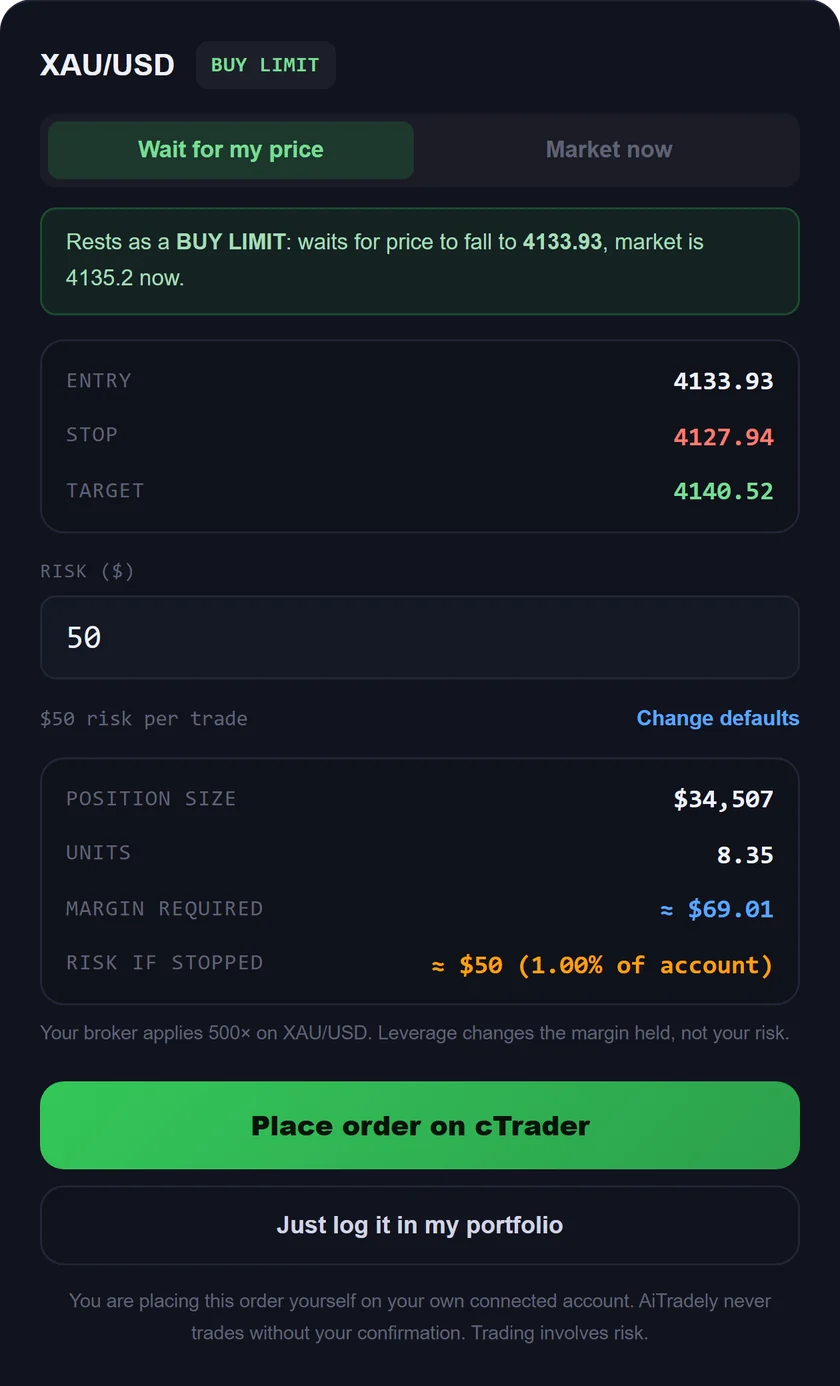
Size from your riskSet your risk in dollars. The app sizes the trade.Type the dollars you accept to lose; AiTradely works out the size from your stop.
Start in your browser
QR code for the AiTradely appPrefer your phone?Scan to get the app

Risk warning. Trading financial markets involves a high risk of loss and is not suitable for everyone. This course is education, not financial, investment or tax advice. The charts are drawn examples, not real prices or predictions. Past behaviour of a market does not guarantee what it does next. You make your own trading decisions.