Lesson 10 · 9 min

News and volatility

Why prices go wild around news, how to see it coming, and what a gap does to your stop.

  1. 1
  2. 2
  3. 3
  4. 4
  5. 5
  6. 6
  7. 7
  8. 8
  9. 9
  10. 10
  11. 11
  12. 12
Step 1

Volatility: how far and how fast

Volatility is how far and how fast a price moves. High volatility means long candles and long wicks: more chance for a big gain, and exactly the same chance for a fast loss. It is not good or bad. It is the size of the waves, and your stop and size have to be chosen for them.

QUIET

VOLATILE

Same market, same number of candles. On the quiet day the candles are tiny; on the wild day each one moves more than the whole quiet day.
Step 2

The economic calendar

The economic calendar lists the scheduled reports for every country, with the time and how much they usually move the market. For gold and the US dollar, the US reports matter most: jobs, inflation and interest rates. Big decisions by central banks and sudden headlines can move markets too, but the calendar covers the ones you can plan around.
EVENTHOW OFTENIMPACT
US jobs reportMonthlyHigh
US inflation (CPI)MonthlyHigh
US interest rate decisionAbout every 6 weeksHigh
US retail salesMonthlyMedium
A few of the events that move gold and the US dollar most. The calendar gives the exact date and time.
Step 3

What happens at the moment of news

Right before news, many traders step away, so the spread widens: the gap between buy and sell (lesson 2) can grow many times its normal size. Then the number comes out and price often jumps one way and snaps back the other, a whipsaw. Stops on both sides get hit before the real direction even shows.
  1. The number comes out: in seconds, price shoots up.
  2. In the same candle it falls even further, and closes below where it started. Buyers and sellers both got stopped out.
4,0804,1004,1204,14012
Step 4

Gaps can skip your stop

A stop loss is an order to close at the next available price once its level is reached. Usually that is very close to the stop. But when the market jumps, or reopens after the weekend at a different price, there is a gap and the stop fills wherever trading starts again. That difference is called slippage, and it is how a $10 plan can lose more.
  1. Friday: you are in a buy at 4,110 with a stop at 4,100, sized for $10 of risk.
  2. Monday: the market opens at about 4,086. There was never a price at 4,100, so the stop fills at the first price there is. The loss is about $24, not $10.
4,0804,0904,1004,1104,120ENTRY 4,110STOP 4,10012
Step 5

A simple news rule

You do not need to predict the news. You only need to never be surprised by it. Four habits do that:
  1. Every morning, check the calendar for high-impact events in the markets you trade.
  2. No new trade from 30 minutes before to 30 minutes after a high-impact event.
  3. Already in a trade? Decide before the news: keep it with its stop and accept that it can slip, or close it.
  4. Weekends: gold and currency markets close on Friday night and can reopen at a different price. Crypto trades all weekend and can jump at any hour.
Step 6

The AI economic calendar

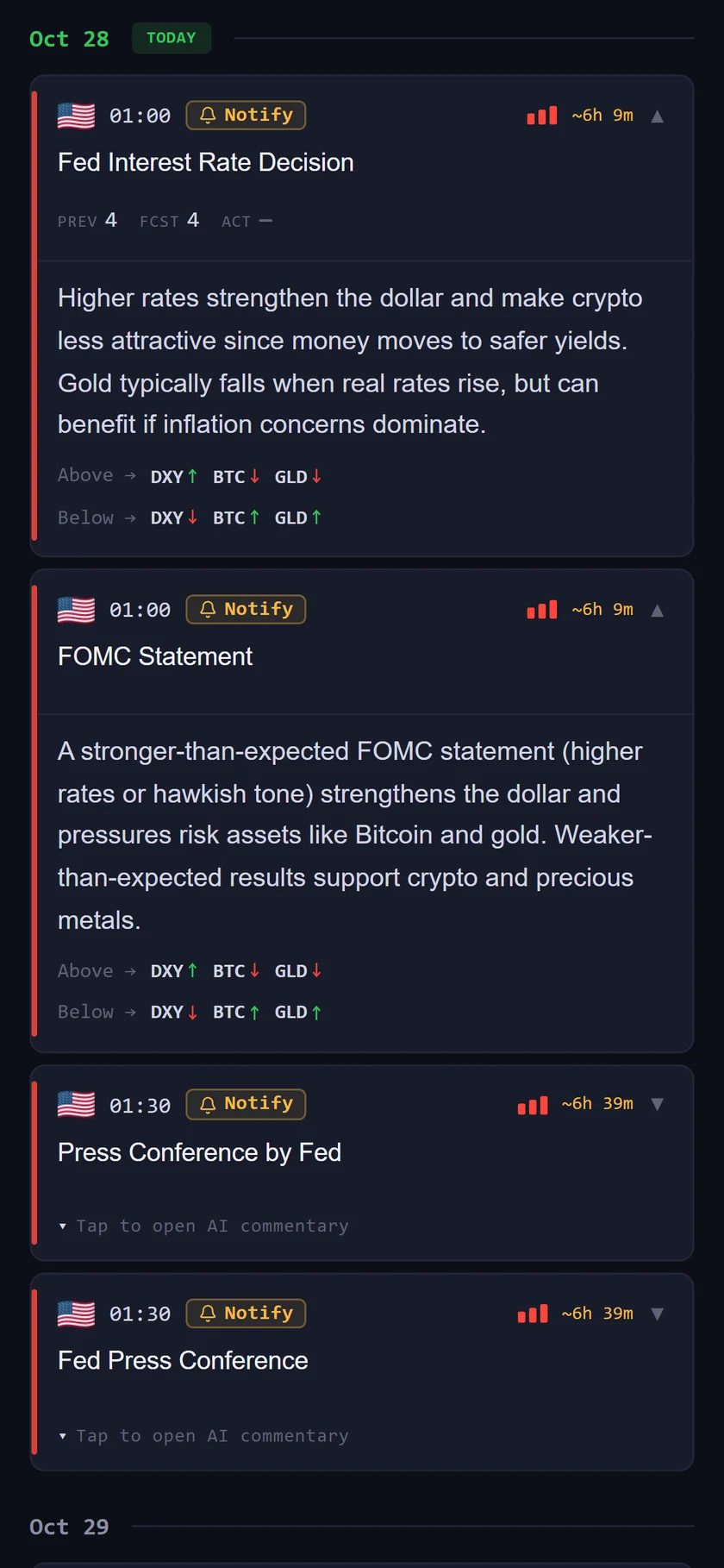
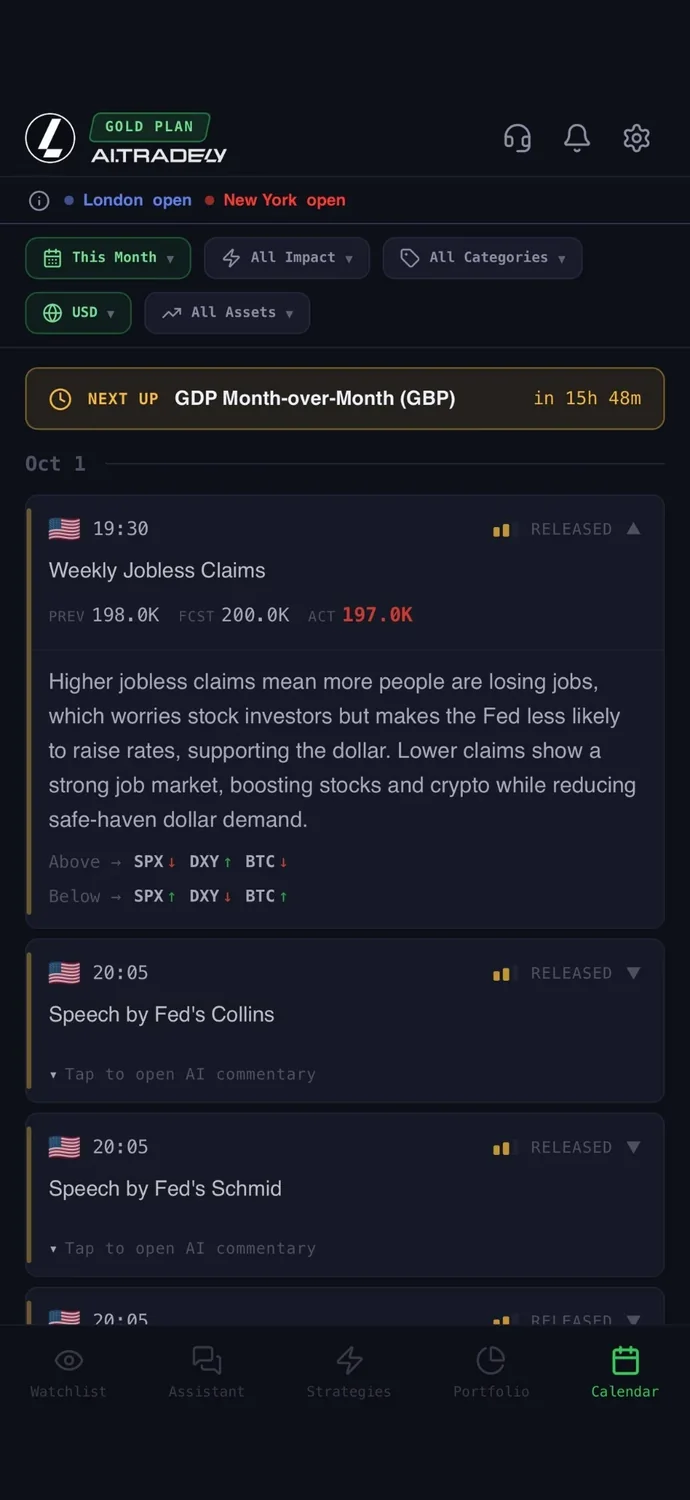
The economic calendar in AiTradely lists every release coming up and how much it can move the market. Open any event and the AI explains it in plain words: what a number above or below the forecast usually means, and for which markets. The green numbers on the screenshot match:
  1. The event: the Fed rate decision, high impact, in six hours. Tap Notify for a reminder before it.
  2. The AI's read: higher rates strengthen the dollar; gold usually falls when real rates rise.
  3. Above or below: the arrows show which way the dollar, Bitcoin and gold tend to move on each outcome.

The same events are marked on the AiTradely chart, like US CPI, so afterwards you can see exactly which candles the news moved.

The AiTradely economic calendar: the Fed interest rate decision with the AI commentary open, and what a higher or lower number means for the dollar, Bitcoin and gold
The calendar in the app on 28 October 2026

Watch out. If you cannot accept a stop being skipped by a jump in price, do not hold a trade through high-impact news, and think twice before holding over the weekend.

Words

New words in this lesson

Volatility
How far and how fast a price moves.
Economic calendar
The schedule of reports and decisions that move markets.
High-impact news
A report that usually moves the market a lot, such as US jobs or inflation.
Whipsaw
A fast move one way, then straight back the other way.
Gap
A jump in price with no trading in between, often after a weekend.
Slippage
The difference between your order's price and the price it actually filled at.
Check yourself

Test yourself

6 questions, 3 of them on a chart. Tap an answer to see right away if it is correct and why. You pass with 5 of 6; retry any time.

1Which chart shows the most volatile market?
A
B
C
2What usually happens to the spread right around big news?
3You bought at the entry with a stop below. Over the weekend price gapped below the stop. What happens to the stop?
4,0804,0904,1004,1104,120ENTRY 4,110STOP 4,100
4A high-impact US inflation report comes out in 10 minutes. What fits the news rule?
5At the news, price shot up and then fell even further in the same candle. What is this called?
4,0804,1004,1204,140
6Where can you see scheduled news ahead of time?
AI economic calendarKnow what the news can do before it landsEvery release coming up, how much it can move the market, and what a higher or lower number means for the dollar, gold and Bitcoin.
Start in your browser
QR code for the AiTradely appPrefer your phone?Scan to get the app
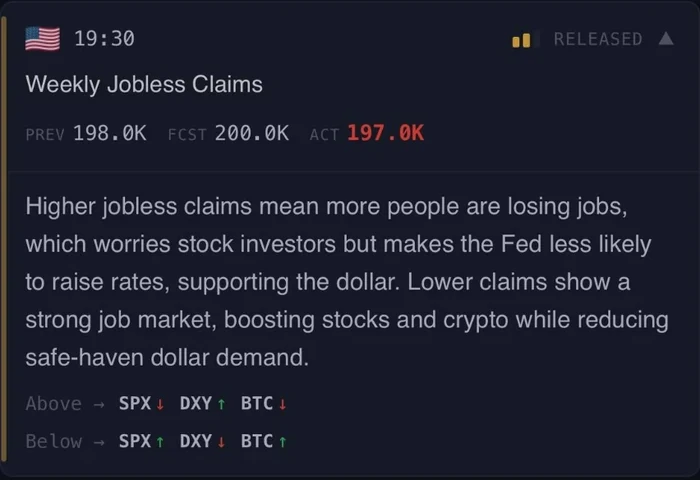
A release in the economic calendar with the AI's note on what it means

Risk warning. Trading financial markets involves a high risk of loss and is not suitable for everyone. This course is education, not financial, investment or tax advice. The charts are drawn examples, not real prices or predictions. Past behaviour of a market does not guarantee what it does next. You make your own trading decisions.