Lesson 11 · 9 min

Psychology and your plan

Fear, greed and the urge to win it back: how feelings break good plans, and the habits that protect you from yourself.

  1. 1
  2. 2
  3. 3
  4. 4
  5. 5
  6. 6
  7. 7
  8. 8
  9. 9
  10. 10
  11. 11
  12. 12
Step 1

Fear and greed

Two feelings cause most trading mistakes. Fear makes you take small wins and avoid good trades. Greed makes you take too much risk when things go well. Both feel reasonable in the moment, which is exactly why the plan is written down before the trade, when you are calm.
FEAR MAKES YOU

Close winning trades long before the target. Skip good trades after a loss. Move the stop closer for no reason.

GREED MAKES YOU

Trade a bigger size after a win. Move the target further away. Hold a loser and hope.

Two feelings, the same result: the plan is broken.
Step 2

Revenge trading

After a loss, the strongest urge in trading is to win it back right now, with a bigger size and a weaker setup. That is revenge trading, and it is how a normal $20 day becomes an $80 day. The losses you planned are not the danger. The trade you take because of them is.
TRADEWHYRESULT
1The plan, $10 risk-$10
2The plan, $10 risk-$10
3Double, to win it back-$20
4Double again-$40
The day-$80
Two planned losses cost $20. The urge to win it back cost another $60.
Step 3

Set limits for the day

Taking trades out of boredom, or because the screen is open, is called overtrading. Two limits stop both overtrading and revenge: a maximum number of trades per day, and a daily loss limit in dollars. Reach either one and you close the app until tomorrow. A bad day then stays a small bad day.
3trades a day, at most
-$30daily loss limit
Decide both numbers before the day starts. When one is reached, the day is over.
Step 4

Your trading plan, on one page

A trading plan is everything from this course on one page: what you trade, which charts, which strategy, how much you risk, your daily limits, your news rule and when you review. Read it before every session. If a trade is not in the plan, it is not a trade.
  • MARKETSGold and EUR/USD only
  • CHARTSDaily for direction, 4 hour for levels, 1 hour for the trigger
  • STRATEGYThe written rule from lesson 9
  • RISK$10 per trade, decided before the entry
  • DAILY LIMIT3 trades or -$30, whichever comes first, then stop
  • NEWSNo new trade 30 minutes before and after high-impact news
  • REVIEWEvery Sunday, read the journal
An example. Yours can be different, but it has to be written.
Step 5

Keep a journal

A trading journal is a simple record of every trade. It turns vague memories (“I always lose on gold”) into facts you can fix. Three moments to write in it:
  1. Before the trade: the market, the reason, entry, stop, target and size.
  2. After it: the result, and one honest line on how you felt and whether you followed the plan.
  3. Every week: read it back. Your biggest losses will almost always be the trades that broke the plan.
Step 6

Start small, then grow

Nobody follows a plan perfectly at first. Make the first mistakes cheap, and only then let them cost more:
  1. Smallest real size: your first 20 to 30 trades with the smallest size your broker allows, following the plan exactly. Real money feels different, and that is the point.
  2. Grow slowly: raise your risk per trade only after many trades that kept the plan, never after one good week.

In AiTradely you set the risk in dollars before every trade and the app works out the size, so starting small is one number, not a calculation.

Watch out. If trading is making you anxious, tired or desperate, stop for the day. No trade is urgent, and the market will still be there tomorrow. If you feel you cannot stop, talk to someone you trust.

Words

New words in this lesson

Fear
The feeling that makes you close winners early and skip good trades.
Greed
The feeling that makes you risk too much after things go well.
Revenge trading
Trading bigger right after a loss to win it back.
Overtrading
Taking trades that are not in the plan, out of boredom or habit.
Daily loss limit
The dollars you can lose in one day before you stop trading.
Trading plan
Your rules for what, when, how and how much you trade, on one page.
Trading journal
A record of every trade, its reason and how you followed the plan.
Check yourself

Test yourself

6 questions, 2 of them with a picture. Tap an answer to see right away if it is correct and why. You pass with 5 of 6; retry any time.

1After two planned losses, this trader doubled the size twice. What went wrong?
TRADEWHYRESULT
1The plan, $10 risk-$10
2The plan, $10 risk-$10
3Double, to win it back-$20
4Double again-$40
The day-$80
2Your trade is in profit and you are scared it will turn. The target is not reached yet. What fits the plan?
3You hit your daily loss limit at lunchtime. What do you do?
4Which journal entry broke the plan?
TRADE AND REASONRESULT
AGold buy at a 4h support zone, stop below it, $10 risk-$10
BEUR/USD buy, “felt it would go up”, no stop-$45
CGold sell at resistance, stop above it, $10 risk+$20
5What belongs in a trading plan?
6When does it make sense to raise your size?
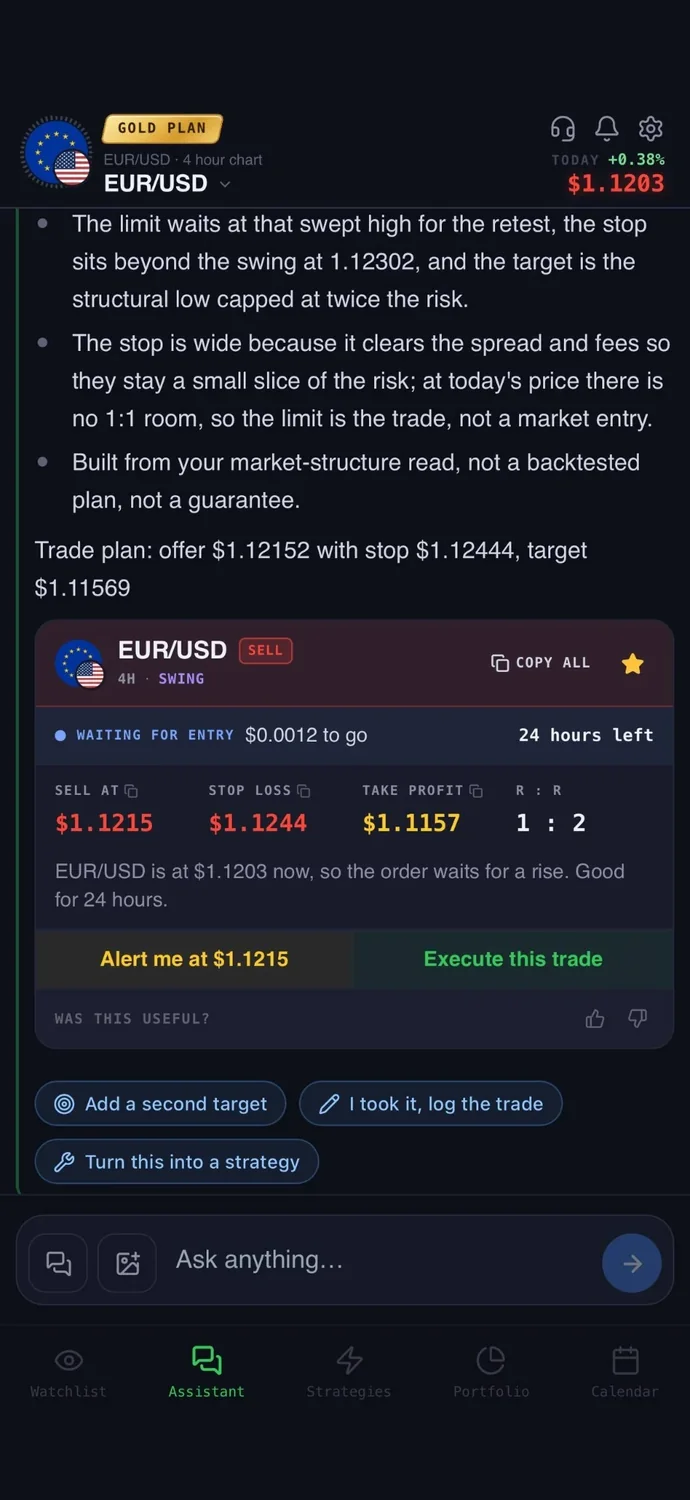
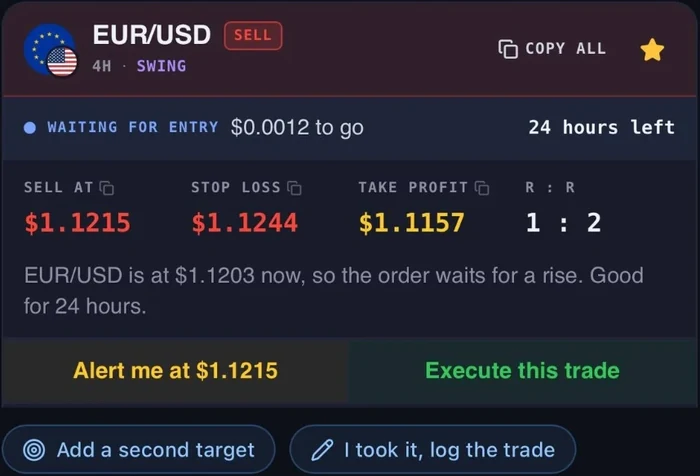
Alerts and journalLet alerts watch the chart for youSet an alert at your level and close the app. Log each trade by telling the AI, and your journal keeps itself.
Start in your browser
QR code for the AiTradely appPrefer your phone?Scan to get the app
An AI trade plan with the button that logs the trade

Risk warning. Trading financial markets involves a high risk of loss and is not suitable for everyone. This course is education, not financial, investment or tax advice. The charts are drawn examples, not real prices or predictions. Past behaviour of a market does not guarantee what it does next. You make your own trading decisions.